

You brush twice a day, possibly three times. You use fluoride toothpaste. You rinse. Your routine is consistent and you know it. Then you sit down in the dental chair, hear the word “cavity,” and feel the particular injustice of someone who has been doing everything right being told that it was not enough.
You were not doing everything wrong. You were doing one thing thoroughly while leaving another thing entirely untouched — and the thing you were leaving untouched is precisely where most cavities begin.
Understanding why requires understanding where toothbrushes work and where they physically stop working. Once you see it, you cannot unsee it — and your dental health changes accordingly.
Where Cavities Actually Form
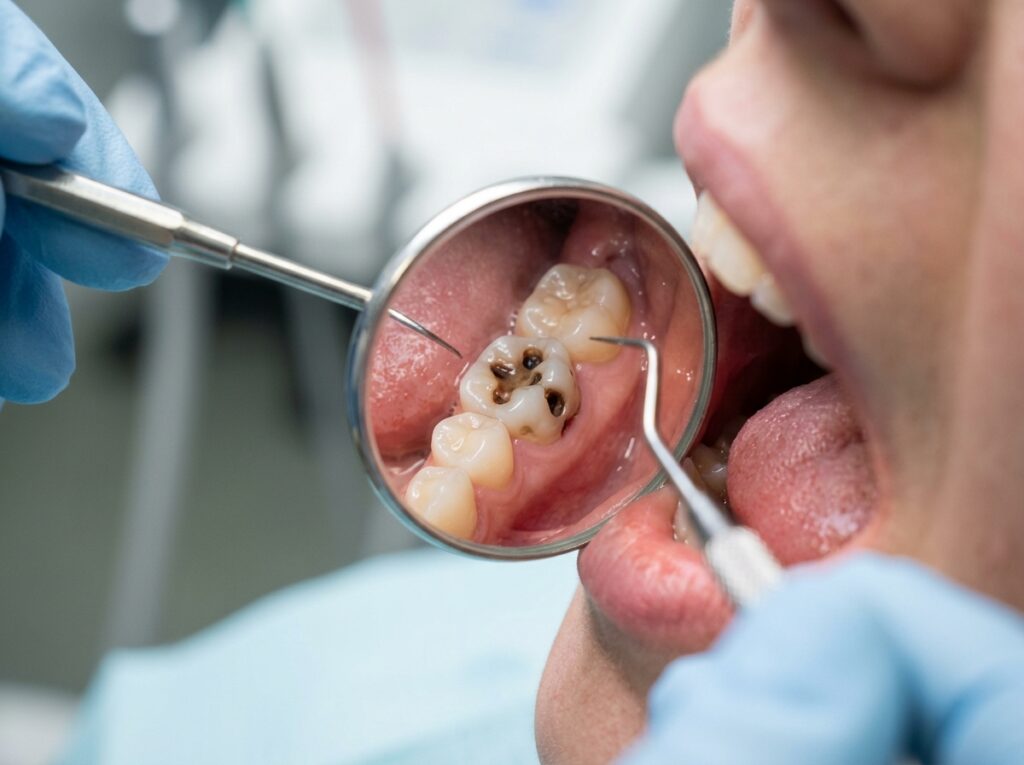
Dental caries — cavities — do not form randomly across tooth surfaces. They concentrate in two predictable locations: the deep grooves on the biting surfaces of molars, and the interproximal spaces — the contact points between adjacent teeth where they touch or nearly touch.
Interproximal cavities account for the majority of decay in adults. They are the ones that appear as dark shadows between teeth on dental X-rays, the ones that expand invisibly for months before becoming symptomatic, and the ones that are most consistently missed by patients who believe their brushing routine is sufficient.
The reason is simple and non-negotiable: a toothbrush bristle cannot fit between teeth that are in contact. The interproximal surface — where tooth meets tooth — is physically inaccessible to any brush, regardless of technique, angle, or bristle softness. An area that cannot be reached by the brush cannot be cleaned by the brush.
What Happens in the Spaces a Brush Misses
The mouth contains over 700 species of bacteria, organized into complex communities called dental biofilm — more commonly known as plaque. Biofilm is not a passive deposit. It is a living microbial structure that adheres to tooth surfaces, metabolizes dietary sugars, and produces acid as a byproduct.
That acid is what creates cavities. When bacterial acid lowers the pH in the immediate environment around the tooth below approximately 5.5, a process called demineralization begins — calcium and phosphate ions are drawn out of the enamel, weakening its crystalline structure. When this occurs repeatedly, across days and weeks, the weakened enamel eventually collapses inward, forming a cavity.
In interproximal spaces, this process is dramatically accelerated. The tight contact between teeth creates an environment where food particles and bacteria accumulate, saliva cannot circulate freely to buffer the acid and remineralize the enamel, and nothing disturbs the biofilm between brushing sessions. The result is a protected, acidic, consistently fed microbial environment — ideal conditions for decay.
Twice-daily brushing removes biofilm from every surface the bristles can reach. It leaves the interproximal surfaces untouched, twice a day, every day, for years.
The One Step That Changes Everything: Interdental Cleaning
Flossing — or any form of interdental cleaning — is the only way to disrupt the biofilm in interproximal spaces. This is not a recommendation based on dental authority preference. It is a mechanical reality: something must physically enter the space between teeth to remove the plaque that accumulates there.
A systematic review published in the Cochrane Database of Systematic Reviews found that flossing in addition to brushing produced significantly greater plaque reduction and marginally lower rates of gingivitis than brushing alone. A large-scale observational study found that people who floss regularly have measurably lower rates of interproximal caries across their lifetime.
The reason flossing’s benefits have been questioned in some media coverage comes down to study design: most randomized controlled trials on flossing run for short durations — weeks, not years — making cavity prevention difficult to demonstrate when cavities take months to form. The mechanistic evidence is sound, the long-term observational data is consistent, and every major dental organization globally recommends interdental cleaning for this reason.
How to floss correctly: The technique matters more than the frequency. Curve the floss into a C-shape against each tooth and slide it gently beneath the gumline — not just snapping it between contact points, which cleans the contact area but misses the subgingival plaque that drives gum disease. Use a clean section of floss for each space. Once daily, before bed, is sufficient for most adults.
Interdental Brushes and Water Flossers
For people who find traditional flossing difficult — those with crowded teeth, fixed bridgework, implants, or limited manual dexterity — two evidence-supported alternatives exist.
Interdental brushes — small cylindrical brushes that fit between teeth — have outperformed traditional floss in several clinical comparisons for plaque removal and gingival health, particularly in adults with slightly larger interproximal spaces. They come in multiple sizes and require a few sessions to identify the correct fit for each space.
Water flossers (oral irrigators) — devices that use a pressurized stream of water to flush interdental spaces — are effective for removing loose food debris and disrupting early-stage biofilm. They are particularly valuable for people with braces, implants, or crowns. Clinical evidence places them slightly below interdental brushes for biofilm removal but significantly above no interdental cleaning at all.
The correct tool is the one that gets used consistently. The most evidence-backed method that remains in the bathroom cabinet provides no clinical benefit.
The Other Factors Brushing Cannot Address
Interdental cleaning is the most significant gap in most adults’ dental hygiene — but it is not the only one.
Fluoride exposure duration: Most people apply fluoride toothpaste and rinse it away within 30 seconds. Fluoride’s remineralizing effect requires contact time with enamel. Spitting without rinsing after brushing — leaving a thin residue of toothpaste on the teeth — meaningfully increases fluoride’s protective effect. This single behavioral change requires no additional products.
Diet and acid exposure: Cavity-causing bacteria require fermentable carbohydrates — sugars and refined starches — to produce acid. The frequency of sugar exposure matters more than the quantity: sipping a sugary drink over two hours maintains a continuously acidic oral environment, while consuming the same amount in one sitting allows pH to recover between exposures. Frequent snacking on refined carbohydrates is one of the strongest dietary predictors of cavity development.
Saliva flow: Saliva is the mouth’s natural defense system — it buffers acid, delivers calcium and phosphate for remineralization, and contains antimicrobial proteins. Chronic dry mouth — caused by medication side effects, mouth breathing, dehydration, or autoimmune conditions — dramatically increases cavity risk regardless of brushing frequency. Over 500 medications list dry mouth as a side effect, making it one of the most underrecognized contributors to adult dental decay.
Xylitol: A natural sugar alcohol found in some gums and mints, xylitol cannot be metabolized by Streptococcus mutans — the primary cavity-causing bacterium. Regular exposure to xylitol has been shown in multiple randomized controlled trials to reduce S. mutans populations in the mouth and decrease cavity rates. Chewing xylitol gum after meals, when brushing is impractical, is an evidence-backed adjunct to standard oral hygiene.
The Complete Protocol
| Step | Frequency | Purpose |
|---|---|---|
| Brushing with fluoride toothpaste | Twice daily, 2 minutes | Removes surface biofilm, delivers fluoride |
| Spit, don’t rinse | After every brushing | Maximizes fluoride contact time |
| Interdental cleaning | Once daily before bed | Removes interproximal biofilm |
| Xylitol gum or mints | After meals when brushing isn’t possible | Reduces cariogenic bacteria |
| Water intake | Throughout the day | Supports saliva flow and acid buffering |
| Dental check-up | Every 6 months | Catches interproximal decay before it expands |
The Bottom Line
Brushing is the foundation of oral hygiene — but it covers roughly 60% of tooth surfaces. The remaining 40% — the interproximal spaces where most cavities actually form — requires a separate tool and a separate habit.
The toothbrush has not failed you. It has simply been asked to do something it was never designed to do. One additional minute each evening, with the right tool in the right place, closes the gap that brushing leaves open.
This article is for informational purposes only and does not replace professional dental advice. Visit your dentist regularly for professional cleaning and individualized cavity prevention guidance.