
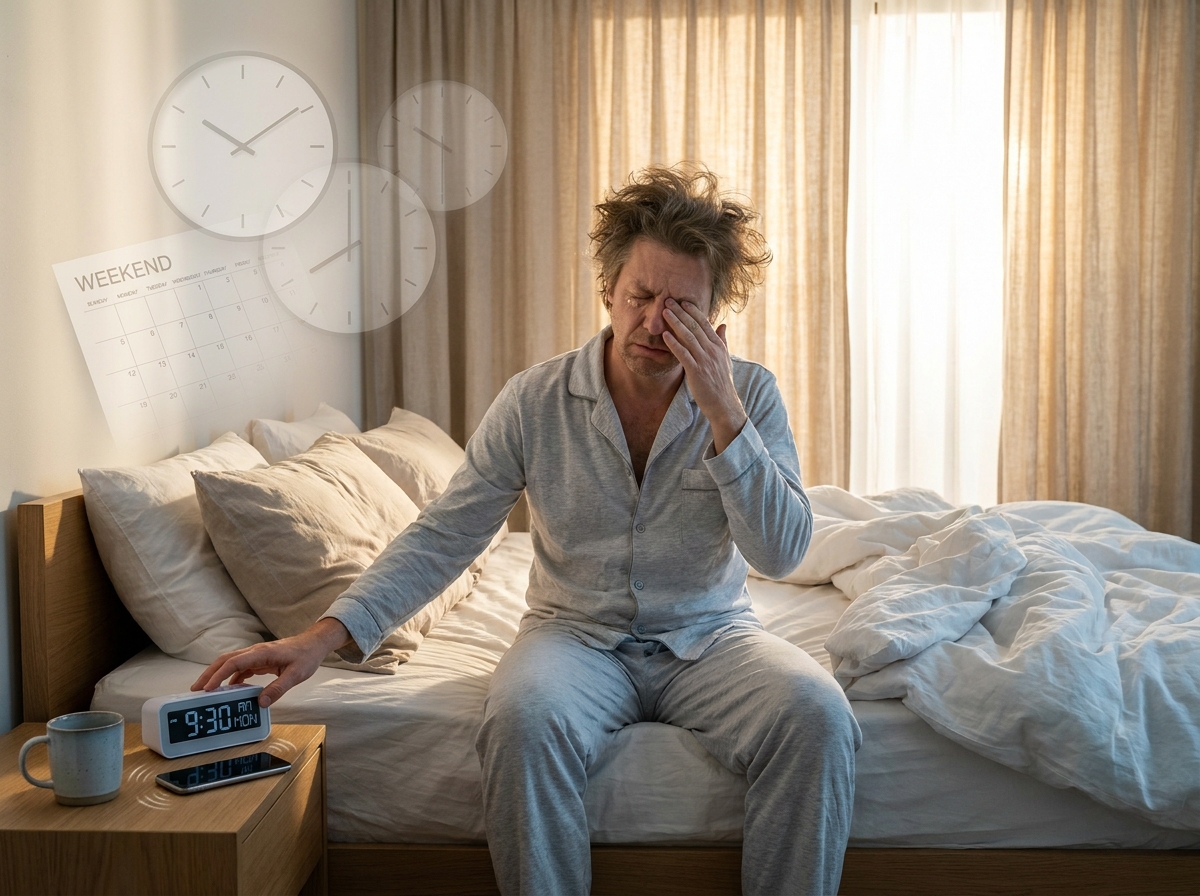
Friday night arrives and permission feels earned. You stay up later than usual, sleep in Saturday morning, do the same Sunday, and set your alarm for Monday with the quiet confidence of someone who has finally caught up on rest. Then Monday hits — and you feel worse than you did on Friday.
If this cycle sounds familiar, you are not alone. Millions of people experience it every single week, dismiss it as Monday blues, and repeat the pattern the following weekend. What very few of them realize is that the extra sleep is not helping them recover. In many cases, it is precisely what is making them feel so depleted.
Sleeping too much is a real physiological phenomenon with measurable consequences — and it is one of the most overlooked topics in mainstream sleep health.
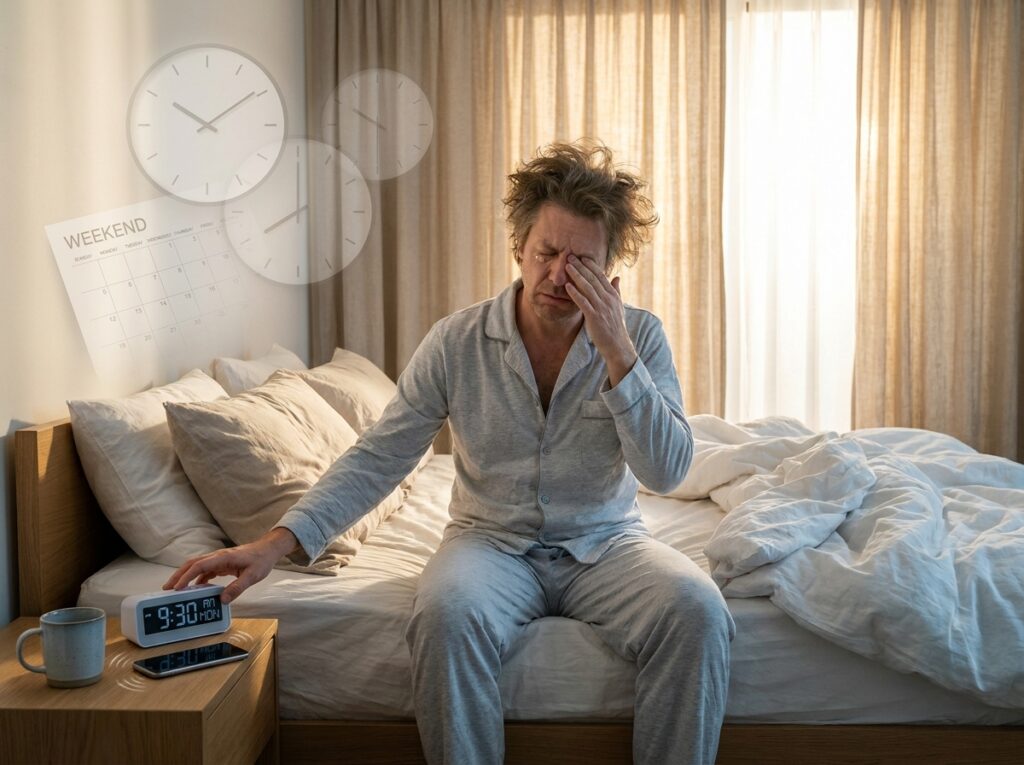
The Sleep Mistake Almost Everyone Makes on Weekends — and Why It Leaves You Drained by Monday
Friday night arrives and permission feels earned. You stay up later than usual, sleep in Saturday morning, do the same Sunday, and set your alarm for Monday with the quiet confidence of someone who has finally caught up on rest.
Then Monday hits — and you feel worse than you did on Friday.
If this cycle sounds familiar, you are not alone. Millions of people experience it every single week, dismiss it as Monday blues, and repeat the pattern the following weekend. What very few of them realize is that the extra sleep is not helping them recover. In many cases, it is precisely what is making them feel so depleted.
Sleeping too much is a real physiological phenomenon with measurable consequences — and it is one of the most overlooked topics in mainstream sleep health.
The Biology Behind Why More Sleep Makes You Feel Worse
To understand why oversleeping backfires, you need to understand one of sleep science’s most important concepts: sleep pressure and circadian rhythm alignment.
Your body manages sleep through two interconnected systems.
System 1: Sleep pressure (adenosine accumulation)
Throughout every waking hour, a chemical called adenosine builds up in the brain. The longer you are awake, the more adenosine accumulates — and the sleepier you feel. Sleep clears adenosine. When you wake after a full night, adenosine levels are low and you feel alert.
System 2: The circadian clock
Your internal 24-hour clock determines when your body expects to be awake and when it expects to be asleep. It regulates body temperature, hormone release, metabolism, and hundreds of gene expression patterns based on consistent timing signals — primarily light and wake time.
These two systems are designed to work together. When you sleep in significantly beyond your normal wake time, you disrupt the circadian clock without meaningfully increasing sleep quality. You wake with low adenosine — which should mean alertness — but your circadian rhythm is now misaligned, your cortisol awakening response has been blunted, and your body is confused about what time it is.
The result is a state sleep researchers call social jet lag — and it feels remarkably like the jet lag you experience after a long-haul flight.
What Is Social Jet Lag — and Why Is It Destroying Your Mondays?
Social jet lag is the discrepancy between your biological clock and your social schedule. It was coined by chronobiologist Till Roenneberg at Ludwig Maximilian University of Munich, whose research across 65,000 participants found that the majority of people in industrialized societies are living in a state of chronic circadian misalignment — primarily caused by inconsistent sleep timing between weekdays and weekends.
The average person shifts their sleep schedule by 1.5 to 2 hours on weekends compared to weekdays. For many people — particularly night owls — that shift is 3 hours or more.
From a biological standpoint, this is equivalent to flying from New York to London every Friday night and flying back every Sunday night. Your body never fully adjusts before the cycle reverses.
The consequences are not limited to Monday fatigue. Roenneberg’s research found that every hour of social jet lag is associated with a 33% increase in the likelihood of obesity, along with elevated markers of inflammation, impaired glucose metabolism, and increased depression risk.
You are not tired on Monday because you didn’t sleep enough. You are tired because you slept at the wrong times — and your body’s master clock is paying the price.
The Oversleeping-Exhaustion Paradox: 5 Mechanisms
1. Sleep Inertia Scales With Sleep Duration
Sleep inertia is the grogginess you feel immediately upon waking — caused by the abrupt interruption of sleep cycles. It typically clears within 15 to 30 minutes after a normal night of sleep.
When you sleep significantly longer than your body needs, you are more likely to wake from deep slow-wave sleep rather than the lighter sleep stages your body naturally progresses toward near your normal wake time. Waking from deep sleep produces dramatically more intense and prolonged sleep inertia — leaving you feeling foggy, disoriented, and exhausted for hours despite having slept more than enough.
2. Cortisol Awakening Response Disruption
Within the first 30 to 45 minutes after waking, the body produces a sharp spike in cortisol — not the chronic stress hormone it is often portrayed as, but a vital alertness and energy-mobilization signal. This cortisol awakening response (CAR) is calibrated to your expected wake time.
When you sleep 2 to 3 hours past your normal wake time, the CAR has already peaked and begun declining before you open your eyes. You wake into a hormonal environment designed for mid-morning rather than for the alertness of a fresh start — and feel sluggish as a result.
3. Adenosine Clearance Without Circadian Readiness
Oversleeping clears adenosine efficiently — which is why you don’t feel sleepy immediately upon waking. But without circadian alignment, the brain lacks the full complement of alertness-promoting signals it normally receives at the synchronized wake time. You are caught between low sleep pressure and low circadian drive — a state that produces flat, unmotivated, low-energy wakefulness.
4. Reduced Sleep Drive for the Following Night
Every hour of extra sleep you take in the morning reduces your adenosine accumulation — your sleep pressure — for the following night. Sleep in until 10 a.m. on Sunday and you may find yourself lying awake until 1 or 2 a.m. Sunday night, unable to fall asleep at a normal time. Monday morning arrives after a shortened, disrupted night — and the cycle of exhaustion perpetuates itself into the week.
5. Increased Inflammatory Markers
Multiple studies — including a large meta-analysis published in the Journal of Sleep Research — have found that consistently sleeping more than 9 hours is associated with elevated C-reactive protein (CRP) and interleukin-6 (IL-6), two key markers of systemic inflammation. The relationship is bidirectional: inflammation causes fatigue, and excessive sleep may both reflect and amplify inflammatory signaling.
When Oversleeping Is a Symptom, Not a Cause
An important distinction deserves attention here: sometimes sleeping more than 8 or 9 hours is not the problem itself — it is the body’s response to an underlying condition.
Persistent hypersomnia — the chronic need to sleep excessively despite adequate nighttime rest — can be a symptom of:
- Depression and anxiety — fatigue and hypersomnia are among the most consistent features of depressive episodes
- Hypothyroidism — a sluggish thyroid dramatically reduces energy and increases sleep need
- Sleep apnea — despite spending 9 or 10 hours in bed, apnea sufferers cycle out of deep sleep hundreds of times per night, leaving them profoundly unrestored
- Chronic fatigue syndrome — characterized by sleep that provides no restoration regardless of duration
- Iron deficiency anemia — reduces oxygen delivery to tissues, driving fatigue and increased sleep need
- Vitamin D or B12 deficiency — both are strongly associated with fatigue and disrupted sleep architecture
If you are consistently sleeping more than 9 hours and still waking exhausted — and this has been true for weeks or months — the answer is not to sleep less. It is to find out why your body is not restoring itself during sleep. A conversation with your doctor and basic blood work is the appropriate starting point.
How Much Sleep Do You Actually Need?
The National Sleep Foundation and the American Academy of Sleep Medicine both recommend 7 to 9 hours for adults — but this range conceals significant individual variation.
Your genuine sleep need is the amount that allows you to:
- Wake without an alarm feeling alert
- Maintain consistent energy through the day without caffeine dependence
- Fall asleep within 20 to 30 minutes at your target bedtime
- Function at full cognitive capacity without an afternoon slump
For most adults, this lands between 7 and 8 hours. Genuine long sleepers — people whose biology requires 9 hours — exist but represent a small minority. For the vast majority of people sleeping 9 or 10 hours regularly, the duration reflects disrupted sleep quality, circadian misalignment, or an underlying condition — not a naturally elevated sleep need.
How to Find Your Sleep Sweet Spot
Step 1: Anchor your wake time first.
Choose a wake time that works for your life and hold it every day — including weekends — within a 30-minute window. This is the single most powerful intervention for circadian alignment and Monday morning energy.
Step 2: Let your sleep onset time adjust naturally.
Once your wake time is consistent, your body will calibrate its sleep drive accordingly. Most people find their natural sleep onset settles 7 to 8 hours before their wake time within 1 to 2 weeks.
Step 3: Resist weekend lie-ins beyond 1 hour.
One hour past your weekday wake time is a reasonable weekend buffer. Two hours or more begins producing measurable circadian disruption. If you feel the need to sleep significantly longer on weekends, that need is a signal that your weekday sleep is insufficient — address the deficit there, not by oversleeping on Saturday.
Step 4: Evaluate sleep quality, not just duration.
If you are spending 8 or 9 hours in bed but waking unrefreshed consistently, the problem is almost certainly sleep quality rather than quantity. Examine sleep architecture disruptors: alcohol, late eating, screen light, inconsistent timing, stress, or possible apnea.
Step 5: Get morning light within 30 minutes of waking.
Bright natural light is the most powerful circadian resynchronizer available. Even on overcast days, outdoor light is significantly brighter than indoor lighting and sends a clear “day has started” signal to the biological clock — accelerating morning alertness and setting the stage for easier sleep onset that night.
The Bottom Line
More sleep is not always better sleep. The relationship between sleep duration and how you feel is not linear — it is a curve, and most people focus exclusively on the left side of it while the right side quietly undermines their energy every weekend.
The goal is not the longest night of sleep you can get. It is the most consistent, well-timed, appropriately deep sleep your biology requires — delivered at the same time, night after night, with enough reliability that your circadian clock never has to guess what day it is.
Fix the timing before you chase the hours. Your Monday self will notice the difference by the end of the first week.
This article is for informational purposes only and does not replace professional medical advice. If you experience persistent exhaustion regardless of sleep duration, consult a qualified healthcare professional to rule out underlying conditions.