
Most people who suspect allergies begin by eliminating things — a food, a pet, a cleaning product — based on pattern recognition between exposures and symptoms. This approach is reasonable as a first step and sometimes identifies the trigger.
More often, it produces a list of avoided substances based on incomplete information, leaving the actual allergen unidentified while potentially creating unnecessary dietary restrictions, stress around exposures, and continued symptoms from the real but untested cause.
Allergy testing replaces guesswork with immunological evidence. It identifies which specific molecules the immune system has mounted an IgE response against, guides targeted avoidance and treatment decisions, and — critically — distinguishes between substances someone is sensitized to (has antibodies against) and substances that actually produce clinical symptoms in them. These are not always the same thing.
Why the Sensitization-Allergy Distinction Matters
A positive allergy test result means the immune system has produced IgE antibodies against a specific allergen. It does not automatically mean clinical allergy — the experience of symptoms upon exposure.
Studies consistently find that 30 to 50% of people with positive skin prick tests or elevated specific IgE levels for a given allergen do not experience reactions on direct exposure. This phenomenon is called sensitization without clinical allergy — IgE is present, but the threshold for mast cell activation sufficient to produce symptoms is not reached in that individual.
Interpreting allergy test results requires correlating them with clinical history. A positive result for peanut in a person who has never eaten peanuts without a reaction is difficult to interpret without an oral challenge. A positive result for cat dander in someone who develops rhinitis immediately upon entering a home with cats is highly clinically meaningful.
An allergist integrates test results with symptom history, exposure patterns, and — when necessary — controlled challenge procedures to determine which positive results are clinically relevant.
When Allergy Testing Is Recommended
Testing is appropriate — and most productive — in the following clinical situations:
- Recurrent, unexplained urticaria (hives) or angioedema
- Chronic rhinitis, nasal congestion, or sneezing without a clear cause
- Suspected food allergy based on consistent reactions after specific foods
- Asthma with suspected allergic triggers
- History of anaphylaxis requiring identification of the causative allergen
- Suspected insect venom allergy following a systemic reaction
- Chronic eczema (atopic dermatitis) unresponsive to standard treatment
- Suspected drug allergy requiring confirmation before prescribing
- Suspected allergic contact dermatitis from occupational or cosmetic exposures
- Before beginning allergen immunotherapy — testing establishes the treatment targets
Testing is less useful for non-IgE mediated conditions — including most food intolerances, irritable bowel syndrome, and delayed gastrointestinal reactions — which do not involve IgE and will not produce positive results on standard allergy tests.
The Four Main Testing Methods
1. Skin Prick Test (SPT)
The most widely used, fastest, and most cost-effective method for detecting IgE sensitization to specific allergens. It is the standard first-line test in most allergy clinics.
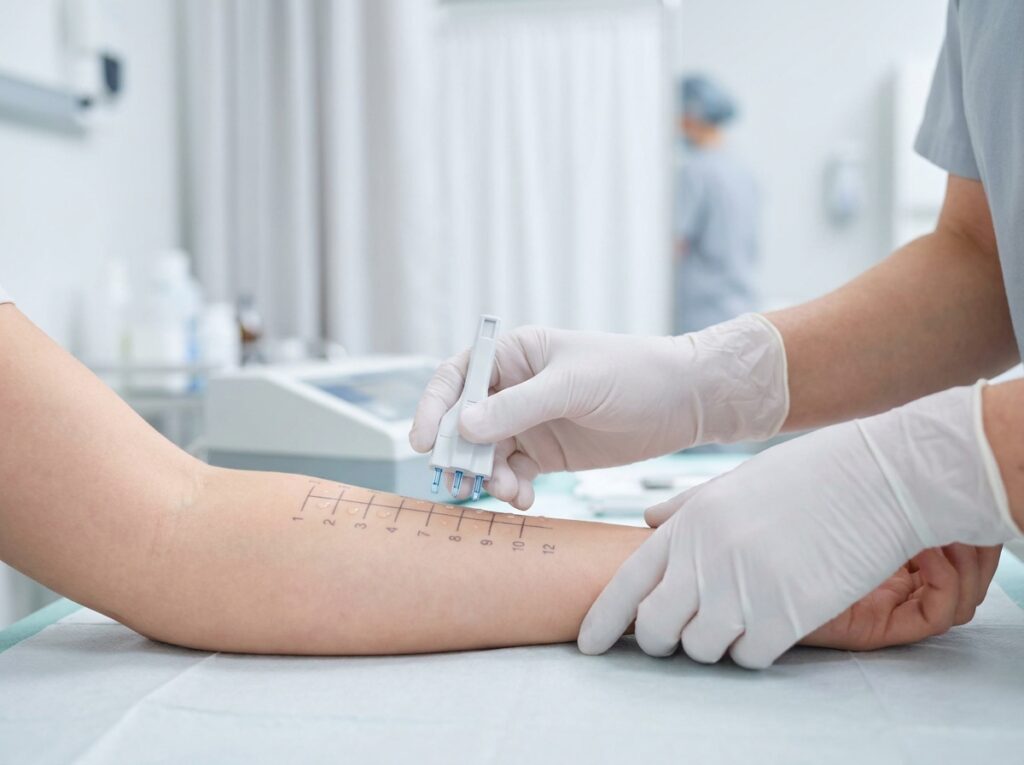
How it works: A small drop of standardized allergen extract is placed on the forearm or upper back, and a lancet is used to lightly prick the skin through the drop — introducing a tiny amount of allergen into the superficial epidermis. Panels typically test 20 to 40 allergens simultaneously, alongside a positive control (histamine, which should produce a reaction) and a negative control (saline, which should not).
Reading the result: After 15 to 20 minutes, a wheal (raised, pale bump) and flare (surrounding redness) form at sites where mast cells in the skin have degranulated in response to the allergen. A wheal diameter 3mm or more greater than the negative control is considered a positive result.
How it feels: A mild prickling sensation — not a needle injection, not painful in the conventional sense. Most patients describe it as less uncomfortable than they expected.
Sensitivity and specificity: High sensitivity (80 to 95% for inhalant allergens, somewhat lower for food allergens). False positives occur — a positive SPT requires clinical correlation, not automatic avoidance.
When SPT cannot be used:
- Active, widespread eczema with no clear skin surface available
- Dermographism (skin that forms wheals from mechanical pressure alone — makes all results uninterpretable)
- Recent anaphylaxis within 4 to 6 weeks (refractory period during which skin reactivity is suppressed)
- Patients unable to stop antihistamines for the required period before testing (typically 3 to 7 days for second-generation antihistamines; longer for some)
2. Intradermal Testing
A more sensitive alternative to skin prick testing. A small amount of diluted allergen extract is injected directly into the dermis (rather than just pricked into the epidermis), producing a small bleb at the injection site. The test is read after 15 to 20 minutes using the same wheal-and-flare criteria.
When it is used: When skin prick testing is negative but clinical suspicion remains high — particularly for drug allergy (penicillin, local anesthetics) and insect venom allergy. It is more sensitive than SPT but also has a higher false-positive rate and carries a slightly elevated risk of systemic reaction.
How it feels: A small burning or stinging sensation at the injection site — more noticeable than SPT but brief.
3. Specific IgE Blood Testing (ImmunoCAP / RAST)
Measures the concentration of IgE antibodies specific to individual allergens in a blood sample. Results are reported in kU/L on a class scale from 0 (undetectable) to 6 (very high).
When it is used:
- When skin testing cannot be performed (severe eczema, dermographism, patient cannot stop antihistamines)
- As a complement to skin testing for specific allergens
- To monitor IgE levels over time during immunotherapy
- In children too young for cooperation with skin testing
Advantages over skin testing: No risk of systemic reaction; not affected by antihistamine use; can be performed regardless of skin condition.
Limitations: Slightly less sensitive than skin prick testing for some allergens; results take days (not 20 minutes); cannot detect IgE-independent immune reactions.
Component-resolved diagnostics (CRD): An advanced form of specific IgE testing that measures antibodies against individual molecular components of an allergen rather than the whole extract. For peanut allergy, for example, Ara h 2 IgE is a specific marker for severe anaphylaxis risk — a patient sensitized to Ara h 2 has significantly higher risk than one sensitized only to Ara h 8 (cross-reactive, usually mild). CRD provides risk stratification beyond a simple positive/negative result.
4. Patch Testing (Epicutaneous Testing)
A completely different test for a completely different immune mechanism — used exclusively for allergic contact dermatitis, a Type IV (delayed, T-cell mediated) hypersensitivity reaction. Standard IgE allergy tests will be negative in contact dermatitis.
How it works: A standardized panel of allergen-impregnated patches (typically 30 to 50 substances — metals, fragrances, preservatives, rubber chemicals, hair dyes) is applied to the upper back under adhesive chambers and left for 48 hours. The patches are removed at 48 hours and the skin is read for reactions at 48 and 96 hours — because contact allergy reactions are delayed, not immediate.
Reading results: Graded from negative to strong positive based on erythema, infiltration, and vesicle formation at each patch site. A positive reaction must be correlated with the patient’s exposure history — a positive to nickel in someone with periumbilical dermatitis under a jeans button is highly clinically relevant.
How it feels: The patches are taped to the back for 48 hours. Patients should avoid sweating, bathing, or physical activity that would dislodge the patches. Itching under a reactive patch during the application period can be intense.
The Oral Food Challenge — The Gold Standard
When blood and skin tests produce ambiguous results for food allergy, the oral food challenge (OFC) provides the definitive answer. The patient consumes the suspected food in graduated doses, under direct medical supervision, with equipment and personnel to manage anaphylaxis immediately available.
The OFC is the only test that directly answers whether clinical allergy is present — not just whether IgE antibodies exist. It is used to:
- Confirm food allergy when history and testing are inconclusive
- Determine whether a previously diagnosed food allergy has resolved (common in milk and egg allergy in children)
- Establish the threshold dose that triggers reactions (relevant for immunotherapy dosing)
What to Do Before Allergy Testing
Stop antihistamines: Second-generation antihistamines (cetirizine, loratadine, fexofenadine) should be stopped 3 to 7 days before skin testing. First-generation antihistamines (diphenhydramine) require 3 days. Failure to stop antihistamines suppresses the skin’s mast cell response and can cause false-negative results.
Do not stop other medications without guidance: Beta-blockers require medical discussion before patch or skin testing — they impair the ability to treat anaphylaxis with epinephrine if a systemic reaction occurs. Do not stop beta-blockers independently.
Continue eating suspected foods: Before food allergy testing, continue consuming the suspected food — stopping it before testing can cause false-negative results and, in some cases, increase reactivity.
This article is for informational purposes only and does not replace professional medical advice. Allergy testing should be performed and interpreted by a qualified allergist or immunologist in a clinical setting with capacity to manage adverse reactions. Do not attempt allergen challenges outside of medical supervision.