

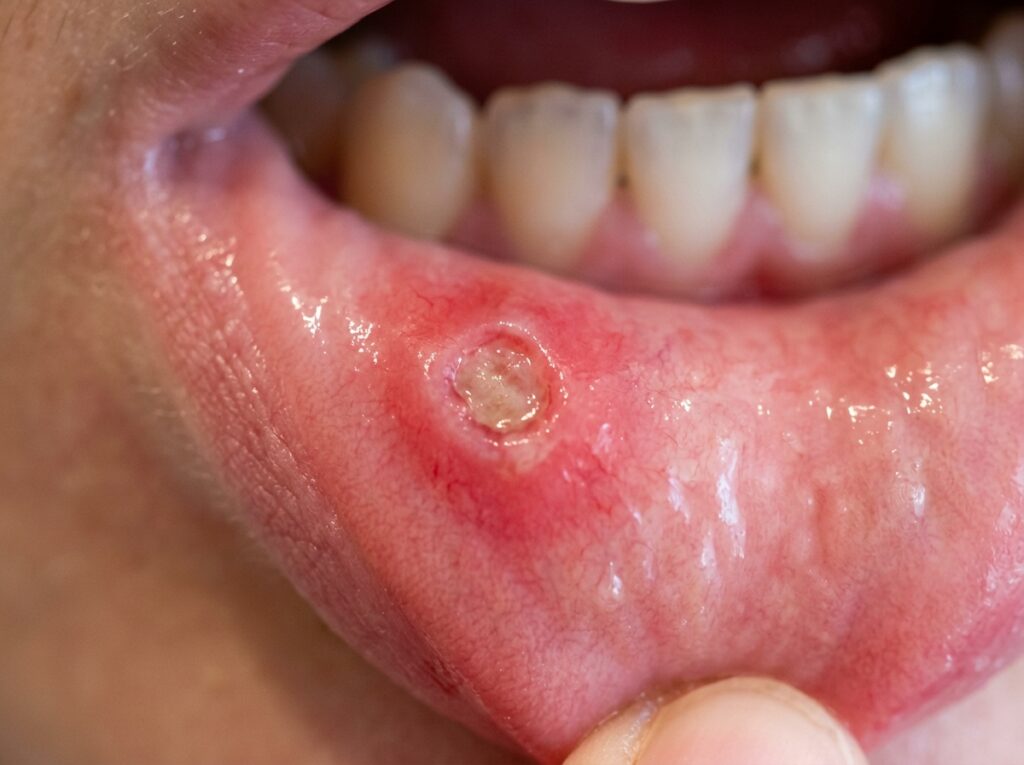
That familiar little sting appears out of nowhere. You run your tongue across the inside of your mouth and feel it instantly: a canker sore. Small, round, with a red border and a whitish center that looks harmless — but hurts far more than something that tiny should.
For most people, canker sores feel random. They show up unexpectedly, make eating and talking miserable, disappear after a few days, and then return weeks later for no apparent reason. When doctors or dentists ask what might be triggering them, the most common answer is: “I don’t know. I’ve always had them.”
But recurrent canker sores are rarely random. They usually have triggers — and one of the most overlooked triggers is a food almost everyone considers healthy. Before revealing the culprit, though, it’s important to understand what a canker sore actually is.
What Is a Canker Sore?
A canker sore — medically called a recurrent aphthous ulcer — is a benign ulcer that forms on the soft tissues inside the mouth.
They can appear:
- On the tongue
- Inside the cheeks
- On the gums
- On the soft palate
- Inside the lips
Typically, they begin with:
- Tingling or burning
- A small red spot
- Followed by a painful ulcer with a white-yellow center and red border
And the pain often feels wildly disproportionate to the size of the lesion.
Importantly:
- It is NOT herpes
- It is NOT contagious
- It is NOT caused by a virus
This is one of the most common misconceptions.
The 3 Types of Canker Sores
Minor Aphthous Ulcers (Most Common)
- Small lesions (2–10mm)
- Usually heal within 7–14 days
- Leave no scar
- Represent about 80% of cases
Major Aphthous Ulcers
- Larger than 10mm
- Deeper and more painful
- May take 2–6 weeks to heal
- Can leave scars
These can significantly interfere with eating and speaking.
Herpetiform Aphthous Ulcers
Despite the name, they are unrelated to herpes.
They appear as:
- Multiple tiny ulcers
- Often clustering together and merging
These are rarer and more frequently associated with systemic conditions.
Early Symptoms Before a Sore Appears
Many people notice warning signs:
- Tingling
- Burning
- Local sensitivity
24–48 hours before the ulcer becomes visible.
Recognizing this early stage allows some people to intervene before the sore fully develops.
The Real Causes — Including the “Healthy” Food Nobody Suspects
1. Tomatoes and Acidic Fruits
Here’s the hidden trigger.
Tomatoes, oranges, lemons, pineapple, strawberries, kiwi, and other acidic foods are among the most common dietary triggers for recurrent canker sores in sensitive individuals.
This is not necessarily a food allergy or intolerance. Instead, these foods irritate the oral mucosa and create conditions favorable for ulcer formation.
Why Tomatoes Are So Sneaky
Tomatoes appear everywhere:
- Pasta sauce
- Salads
- Sandwiches
- Juice blends
- Daily meals
Because people eat them so often, they rarely connect them to the sores.
Simple Test
Remove:
- Tomatoes
- Citrus fruits
- Pineapple
- Strawberries
for 3 weeks and observe whether outbreaks decrease.
For some people, this single change dramatically reduces recurrence.
Other Common Food Triggers
Nuts and Peanuts
Rich in arginine, an amino acid linked to oral lesion formation in some sensitive individuals.
Dark Chocolate
Also contains arginine and irritating compounds.
Spicy and Highly Seasoned Foods
Hot peppers, vinegar, and aggressive seasonings directly irritate the oral lining.
Gluten
In people with undiagnosed celiac disease, recurrent canker sores may actually be the only visible symptom.
Stress and Poor Sleep
One of the strongest triggers.
Chronic stress:
- Raises cortisol
- Weakens local immunity in the mouth
- Alters the oral microbiome
Which creates the perfect environment for ulcers.
This is why many people develop sores:
- During exams
- After emotional conflict
- During work overload
Physical Trauma Inside the Mouth
Common mechanical causes include:
- Accidentally biting your cheek or tongue
- Brushing too aggressively
- Orthodontic braces irritating tissue
- Sharp or crunchy foods
The injury creates the starting point for the ulcer.
Nutritional Deficiencies
Recurrent canker sores are strongly associated with deficiencies in:
- Iron
- Vitamin B12
- Folate
- Zinc
These nutrients are essential for oral tissue repair and regeneration.
Frequent unexplained sores deserve blood testing.
Hormonal Changes
Many women notice more frequent sores:
- Before menstruation
- During pregnancy
- After hormonal contraceptive changes
Hormonal fluctuations directly affect oral tissue sensitivity.
Diseases That Can Cause Recurrent Canker Sores
Frequent or unusually severe ulcers may signal underlying conditions such as:
- Celiac disease
- Crohn’s disease
- Behçet’s disease
- Lupus
- HIV-related immunosuppression
This is especially important when sores are:
- Large
- Numerous
- Persistent
- Accompanied by other symptoms
Your Toothpaste May Be Contributing
A surprisingly important detail:
many toothpastes contain Sodium Lauryl Sulfate (SLS) — the foaming agent.
Research suggests SLS:
- Dries and irritates the oral lining
- Makes tissue more vulnerable to ulcers
Switching to an SLS-free toothpaste reduced canker sore frequency significantly in some studies.
Worth testing.
How Long Do Canker Sores Last?
- Minor sores: 7–14 days
- Major sores: 2–6 weeks
- Herpetiform ulcers: 1–4 weeks
If a sore lasts:
- More than 3 weeks
- Keeps growing
- Develops hard or irregular edges
medical or dental evaluation is essential.
Persistent oral ulcers occasionally require biopsy to rule out more serious conditions.
What Actually Helps
Chlorhexidine Mouthwash
0.12% chlorhexidine reduces bacterial colonization and may speed healing.
Triamcinolone Dental Paste
One of the most effective over-the-counter treatments.
This topical corticosteroid:
- Reduces inflammation
- Decreases pain
- Shortens healing time
Low-Level Laser Therapy
Available in dental offices.
Can:
- Reduce pain almost immediately
- Accelerate healing significantly
Baking Soda Rinses
Warm water with baking soda temporarily neutralizes acidity and decreases irritation.
What to Avoid During an Outbreak
- Acidic foods
- Alcohol
- Carbonated drinks
- Spicy foods
- Aggressive brushing near the lesion
How to Prevent Recurring Canker Sores
- Identify your personal food triggers
- Switch to SLS-free toothpaste
- Manage stress and improve sleep
- Correct iron, B12, folate, and zinc deficiencies
- Protect oral tissue if you wear braces
- Avoid habitual cheek or tongue biting
Conclusion
Canker sores are not random bad luck.
They are symptoms — and symptoms usually have causes and triggers that can be identified.
For people who have suffered from recurrent ulcers for years believing “that’s just how I am,” the good news is that relatively small changes in:
- Diet
- Toothpaste
- Stress levels
- Nutritional status
can dramatically reduce both frequency and severity.
And sometimes, the biggest culprit is the tomato you’ve been putting on everything for years — without ever suspecting it.
Know someone constantly struggling with canker sores? Share this article — it might finally help them connect the dots.