
A blind pimple is not simply a pimple that hasn’t surfaced yet. It is a structurally different type of lesion that forms deeper in the skin, has no opening to the surface, and requires an entirely different approach from every other type of acne.
The methods that work on surface pimples — squeezing, drying spot treatments applied aggressively, warm compresses applied immediately — either fail or actively worsen a blind pimple.
Understanding why requires understanding what is actually happening beneath the skin.
What a Blind Pimple Is — and Why It’s Different
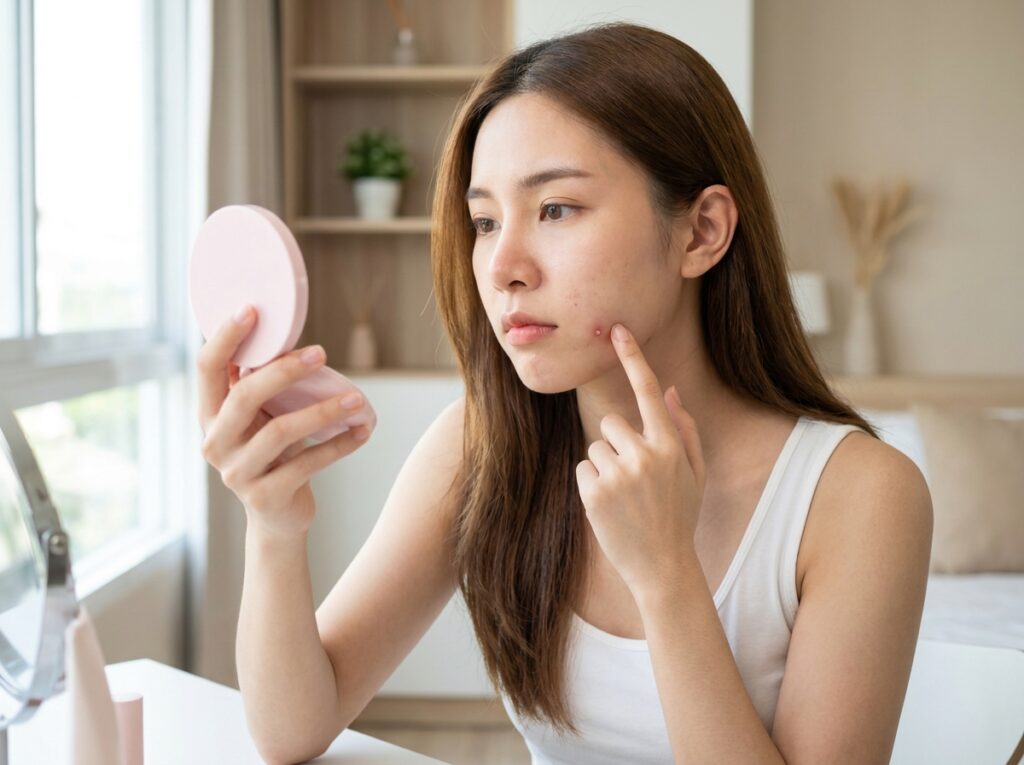
A blind pimple is an inflamed acne lesion — typically a nodule or deep papule — that forms entirely within the dermis, with no comedone opening at the skin surface. In a standard pustule, the follicle is blocked near the skin’s surface and the inflammatory contents have a relatively short path to rupture outward. In a blind pimple, the inflammation has developed deep within the dermis, where nerve endings are dense, blood supply is rich, and there is no exit point for the pressure building inside.
The result is a lesion that is:
- Felt before it is seen — a deep, painful lump detectable by touch before any surface change is visible
- Consistently more painful than surface pimples — the dermis contains pain receptors that the superficial epidermis does not
- Resistant to standard spot treatments — products applied to the skin surface cannot penetrate deeply enough to reach the lesion
- Prone to prolonged inflammation — without a surface opening, the immune response that generates pus and inflammatory mediators has nowhere to drain, extending the duration of the lesion
The biological sequence: a microcomedone forms deep in the follicle, sebum and Cutibacterium acnes accumulate, the follicle wall ruptures below the skin surface, and the immune system dispatches white blood cells to the site. This cascade generates the heat, swelling, and pain characteristic of a blind pimple — entirely below the skin’s surface.
The Three Stages — and Why Stage Determines Treatment
The most important clinical insight about blind pimples is that the correct treatment changes depending on which stage the lesion is in. Applying the same approach throughout produces poor results.
Stage 1 — Early inflammation (hours 0 to 48): The lesion is a deep, firm, painful lump. No head is visible. The follicle wall has ruptured internally and the inflammatory response is active and escalating. The skin over the lesion may appear slightly red or feel warm. This is the stage when most people make the most consequential treatment error: applying heat.
Stage 2 — Peak inflammation (days 2 to 5): The immune response is at maximum intensity. The lesion may be at its largest and most painful. A small white or yellow head may begin to form at the surface as the inflammatory contents find a path toward the epidermis. Not all blind pimples develop a visible head — some nodules reabsorb without surfacing.
Stage 3 — Resolution (days 5 to 14+): The lesion either develops a drainable head, reabsorbs into the skin, or — in severe cases — progresses to a cyst. Post-inflammatory redness or hyperpigmentation at the site typically persists for weeks after the active lesion resolves.
The Step-by-Step Treatment Protocol
Stage 1: The First 24 to 48 Hours
Apply ice immediately — not heat.
This is the most counterintuitive and most important instruction in blind pimple management. Heat increases local blood flow and amplifies the inflammatory response — exactly what should not happen during the acute inflammation phase. Ice constricts blood vessels, reduces the delivery of inflammatory mediators to the site, and decreases swelling and pain.
Wrap an ice cube in a clean cloth and apply to the lesion for 5 minutes on, 5 minutes off, for two to three cycles. Repeat two to three times daily during Stage 1. This will not eliminate the lesion but meaningfully reduces its ultimate size and duration when applied early.
Apply a targeted benzoyl peroxide spot treatment.
Benzoyl peroxide kills C. acnes through an oxidative mechanism and reduces inflammation. At 2.5 to 5%, it is the most evidence-backed topical treatment for inflammatory acne. Apply a small amount directly to the lesion at night. Concentrations above 5% produce no additional benefit and substantially increase irritation.
Apply a salicylic acid treatment.
Salicylic acid is a beta-hydroxy acid that penetrates the oil-filled follicle and dissolves the keratinous material contributing to the blockage. A 2% salicylic acid product applied to the lesion in the morning (benzoyl peroxide at night, salicylic acid in the morning — they should not be layered simultaneously) addresses the comedogenic component of the lesion from the surface down.
Do not apply a hydrocolloid patch at this stage.
Hydrocolloid patches are highly effective for surface pimples with a visible head — they absorb the fluid from a rupturing lesion and create a healing environment. Applied to a blind pimple with no surface opening, they do nothing for the lesion itself. Save them for Stage 2.
Stage 2: Days 2 to 5 — If a Head Is Forming
Switch from ice to a warm compress — only if a white or yellow head is visible.
Once a head has formed at the surface, the inflammatory contents are close enough to the skin surface that gentle heat can help facilitate natural drainage. Apply a clean warm (not hot) compress to the lesion for 10 minutes, twice daily. The warmth softens the skin over the lesion and may help the head come to a natural point.
Apply a hydrocolloid patch over the visible head.
Once a white or yellow center is clearly visible at the skin surface, a hydrocolloid patch worn overnight draws out the fluid, creates a moist healing environment that reduces scarring risk, and protects the lesion from manual interference. Replace with a fresh patch each morning until the lesion drains completely.
Do not manually squeeze — even with a visible head.
The temptation to extract is highest at this stage, and the harm from squeezing is also highest. A blind pimple’s follicle wall is already damaged internally. Manual pressure pushes inflammatory contents sideways into surrounding tissue rather than outward through the small surface opening, spreading inflammation into a wider area and dramatically increasing the risk of scarring and a new, larger lesion forming beside the original.
Stage 3: Resolution — Treating What’s Left
Post-inflammatory hyperpigmentation (PIH): The flat, discolored mark remaining after the active lesion resolves is not a scar — it is temporary pigment deposition from the inflammatory response. It fades over four to eight weeks without treatment, and faster with:
- Niacinamide (4 to 10%): Reduces melanin transfer to the skin surface, lightening PIH over six to eight weeks
- Azelaic acid (10 to 20%): Both anti-inflammatory and depigmenting — addresses PIH and reduces risk of new lesions simultaneously
- Daily SPF 30+ sunscreen: UV exposure darkens post-inflammatory marks significantly — sun protection is non-negotiable during PIH resolution
For reabsorbing nodules: If the blind pimple does not develop a head and begins to flatten without draining, continue benzoyl peroxide and salicylic acid applications until the lesion fully resolves. These lesions typically take two to three weeks to reabsorb completely.
What Never to Do
Squeeze or pick: The most important contraindication. A blind pimple with no surface opening has nowhere for pressure to go except deeper into the dermis — rupturing intact follicle walls, spreading C. acnes into surrounding tissue, and converting a single nodule into a larger inflammatory mass. The resulting damage is the most common cause of deep, permanent acne scarring.
Apply heat in Stage 1: Accelerates the inflammatory process at the moment when reducing it is the priority.
Layer multiple harsh actives: Applying retinoids, benzoyl peroxide, salicylic acid, and an acid toner simultaneously to an already inflamed area destroys the skin barrier, creates significant irritation, and slows healing.
Pop with a needle at home: Creates an entry point for bacteria without the sterile technique required to do so safely — introduces infection risk and does not address the deep follicular contents.
When to See a Dermatologist
A single dermatologist visit is warranted — and highly effective — in two specific situations:
Intralesional corticosteroid injection: A small amount of diluted triamcinolone injected directly into a nodule or cyst by a dermatologist produces dramatic resolution within 24 to 48 hours. It is the fastest available treatment for a large, painful blind pimple and is particularly appropriate before a significant event. The treatment takes under two minutes in the office.
Recurring blind pimples in the same location: A nodule that recurs repeatedly at the same site may indicate a persistent deeper follicular abnormality — including a pilar cyst or calcified lesion — that requires evaluation rather than repeated topical management.
This article is for informational purposes only and does not replace professional medical or dermatological advice. Persistent, recurring, or severely painful nodules and cysts should be evaluated by a board-certified dermatologist rather than managed at home alone.