
Acne is the most common skin condition in the world — affecting an estimated 85% of people between the ages of 12 and 24, and a growing proportion of adults well beyond that range.
Despite its prevalence, it is consistently undertreated, mistreated, and misunderstood. Most people manage it reactively with whichever product claims the fastest result, without knowing which type of acne they have, which mechanism is driving it, or which treatments are actually matched to their specific presentation.
That mismatch is why so many people spend years cycling through products that partially work, or stop working, or work for one type of lesion but not another. Acne is not one condition with one treatment. It is a spectrum of distinct lesion types with distinct mechanisms — and identifying where on that spectrum a person’s acne falls determines which treatment will be effective.
What Is Actually Happening in the Skin
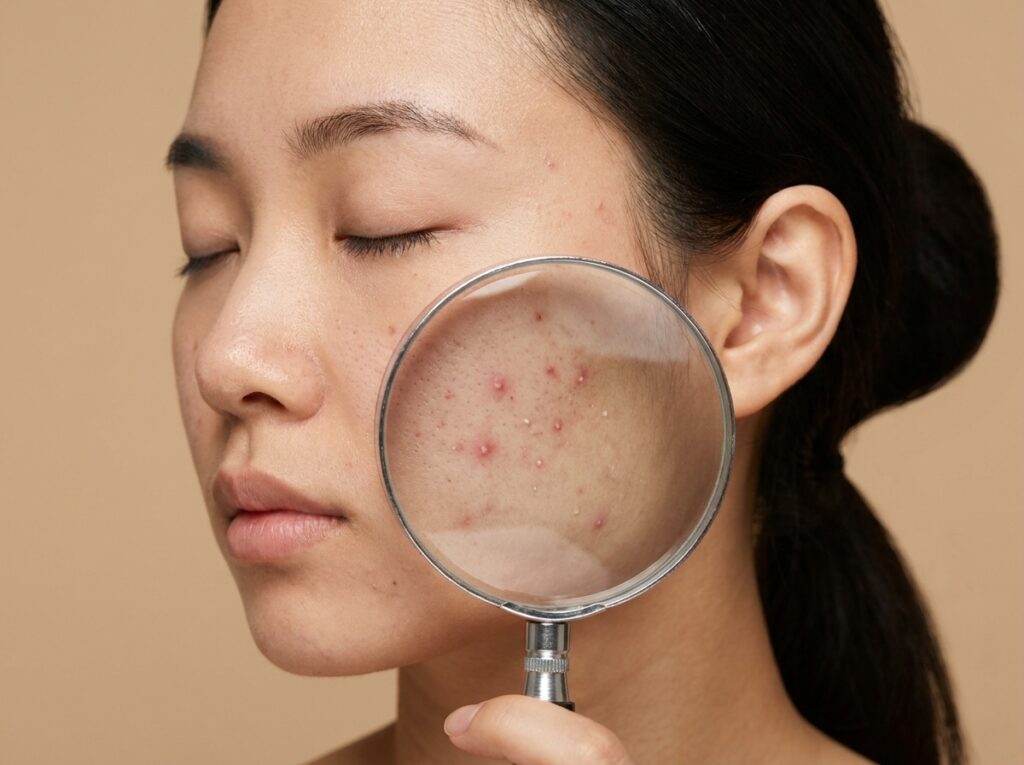
Acne is a disease of the pilosebaceous unit — the hair follicle and its associated sebaceous (oil) gland. Four factors interact to produce acne lesions, and all four must be present to some degree for acne to develop:
1. Excess sebum production: Androgens — particularly dihydrotestosterone (DHT) — stimulate sebaceous glands to produce more oil. This is why acne correlates with puberty, the menstrual cycle, and conditions like PCOS — all involve elevated or fluctuating androgens.
2. Abnormal follicular keratinization: Dead skin cells inside the follicle fail to shed normally and accumulate, forming a plug (microcomedone) that blocks the follicle opening. This is the foundational lesion from which all other acne lesions develop.
3. Cutibacterium acnes proliferation: This anaerobic bacterium (formerly called Propionibacterium acnes) normally lives on the skin in small numbers. When a follicle is blocked and filled with sebum, C. acnes proliferates rapidly in the oxygen-depleted environment.
4. Inflammatory response: The immune system detects C. acnes and its byproducts, triggering inflammation that produces the redness, swelling, pain, and pus associated with inflammatory acne — and the tissue damage that leads to scarring.
Different treatments target different steps in this sequence. Understanding which step is most active in a given person’s acne guides treatment selection far more accurately than choosing based on severity alone.
The Types of Acne — and What Each One Means
Non-Inflammatory Acne
- Open comedones (blackheads): A follicle plugged with sebum and dead skin cells, open at the surface. The dark color is not dirt — it is oxidized melanin exposed to air. Treatment: comedolytic agents (retinoids, salicylic acid) that normalize follicular keratinization.
- Closed comedones (whiteheads): A plugged follicle sealed beneath the surface. Appear as small, flesh-colored or white bumps. Same mechanism as blackheads but without surface opening. Treatment: retinoids are the most effective comedolytic agents available.
Inflammatory Acne
- Papules: Small, raised, red, tender bumps without a visible pus-filled center. Indicate early inflammatory response to C. acnes within a closed follicle. Treatment: benzoyl peroxide, topical antibiotics combined with benzoyl peroxide, retinoids.
- Pustules: Papules with a visible white or yellow center — the pus is a collection of white blood cells, sebum, and bacterial debris. The inflammatory process is more advanced than in papules. Treatment: same agents as papules; do not squeeze — rupturing the follicle wall spreads inflammation into surrounding tissue.
- Nodules: Large, solid, deep, painful lesions extending into the dermis. Result from severe inflammation and follicle rupture below the skin surface. High risk of scarring. Require prescription-strength treatment.
- Cysts: The most severe acne lesions — fluctuant (fluid-filled), painful, deep, and virtually guaranteed to scar without appropriate treatment. Represent a significant immune response to follicle rupture. Prescription management is essential.
Hormonal Acne
A distinct clinical pattern — predominantly inflammatory papules and pustules concentrated along the jawline, chin, and lower cheeks, often flaring in the week before menstruation. Driven by cyclic androgen fluctuation. Responds poorly to topical antibiotics and better to anti-androgen interventions (combined oral contraceptives, spironolactone in women, topical clascoterone).
Adult Acne
Acne persisting beyond age 25 or developing for the first time in adulthood. Increasingly common — particularly in women. Triggers include hormonal changes, stress (cortisol stimulates androgen production), dietary factors, and comedogenic skincare products. Often presents as a mixed pattern of deep inflammatory lesions and closed comedones in the lower face.
Causes and Modifiable Triggers
Beyond the four-factor biological mechanism, several external factors consistently worsen acne:
Diet: High-glycemic foods (refined carbohydrates, sugar, sweetened beverages) increase insulin and IGF-1 (insulin-like growth factor 1), which stimulate sebum production and androgen activity. Multiple prospective studies confirm the diet-acne connection. Dairy — particularly skim milk — is the most consistently implicated food, likely through IGF-1 content and whey protein’s insulinotropic effect.
Stress: Cortisol stimulates adrenal androgen production and increases sebum output. Chronic stress predictably worsens inflammatory acne.
Comedogenic products: Certain skincare and makeup ingredients clog follicles — particularly mineral oil, lanolin, certain silicones, and isopropyl myristate. “Non-comedogenic” labeling is not regulated but provides a useful starting point.
Friction and pressure: Acne mechanica — caused by helmets, face masks, phone contact with the cheek, chin straps, or tight clothing — triggers acne at contact sites through mechanical follicle irritation.
Medications: Corticosteroids, lithium, some anticonvulsants, and anabolic steroids can trigger or worsen acne through androgen-related and direct follicular mechanisms.
The Treatment Ladder
Step 1 — Over-the-Counter Actives
- Benzoyl peroxide (2.5% to 10%): The most important OTC acne ingredient. Kills C. acnes through oxidative mechanism, reduces inflammation, and — critically — does not promote bacterial resistance (unlike topical antibiotics used alone). Effective for inflammatory papules and pustules. Start at lower concentrations (2.5 to 5%) to minimize irritation; efficacy is equivalent to higher concentrations with less dryness.
- Salicylic acid (0.5% to 2%): A beta-hydroxy acid that penetrates the oil-filled follicle and dissolves the keratinous plug. Most effective for comedonal acne (blackheads, whiteheads, milia). Less effective for deep inflammatory lesions.
- Adapalene 0.1% (Differin): A third-generation retinoid now available OTC in many markets — the most significant advance in accessible acne care in decades. Normalizes follicular keratinization, prevents microcomedone formation, and has anti-inflammatory properties. The first-line choice for both comedonal and mild-to-moderate inflammatory acne. Requires 8 to 12 weeks of consistent use before results are meaningful — the most common reason people abandon it.
Step 2 — Prescription Topical Treatment
- Tretinoin (0.025% to 0.1%): The gold standard topical retinoid, available by prescription. More potent than adapalene with a stronger comedolytic and anti-inflammatory effect. Requires careful introduction (start with lower concentrations, apply every other night, use with moisturizer) to minimize the retinoid adjustment period (initial dryness, flaking, temporary worsening).
- Topical antibiotics (clindamycin, erythromycin): Target C. acnes colonization. Must always be prescribed in combination with benzoyl peroxide — antibiotic monotherapy rapidly selects for resistant C. acnes strains that are then untreatable with the same antibiotic.
- Azelaic acid (15% to 20%): Anti-inflammatory, antibacterial, and comedolytic. Particularly effective for post-inflammatory hyperpigmentation and for patients who cannot tolerate retinoids. Safe in pregnancy.
Step 3 — Oral Medications
- Oral antibiotics (doxycycline, minocycline): Reserved for moderate-to-severe inflammatory acne. Effective but should be limited to three to six months maximum and always combined with benzoyl peroxide to prevent resistance development.
- Combined oral contraceptives (women): Reduce ovarian androgen production — effective for hormonal acne with a jawline/chin distribution. Three formulations are FDA-approved for acne: norgestimate/ethinyl estradiol, norethindrone/ethinyl estradiol, and drospirenone/ethinyl estradiol.
- Spironolactone (women): An aldosterone antagonist with anti-androgenic properties — reduces sebum production and improves hormonal acne. Off-label for acne but widely used and highly effective for the adult female hormonal acne pattern.
- Isotretinoin: The most effective acne treatment that exists — capable of producing long-term remission in severe nodulocystic acne. Reduces sebaceous gland size and output by 90%, normalizes follicular keratinization, and eliminates C. acnes colonization. Reserved for severe, scarring, or treatment-resistant acne due to its teratogenicity (absolutely contraindicated in pregnancy) and requirement for close medical monitoring.
The Most Common Treatment Mistakes
Stopping too soon: Acne treatments require 8 to 12 weeks of consistent use before meaningful improvement. Most people discontinue at 3 to 4 weeks, concluding the treatment doesn’t work.
Picking and squeezing: Ruptures the follicle wall, spreads inflammation into surrounding dermis, and is the primary behavioral cause of post-acne scarring.
Over-washing: Washing more than twice daily strips the skin barrier, triggers reactive sebum overproduction, and worsens acne over time.
Using topical antibiotics without benzoyl peroxide: Generates antibiotic-resistant C. acnes within weeks, rendering the antibiotic permanently ineffective for that patient.
This article is for informational purposes only and does not replace professional medical advice. Moderate-to-severe acne, acne producing scarring, or acne unresponsive to over-the-counter treatment warrants evaluation by a board-certified dermatologist. Do not use isotretinoin without medical supervision.