
Most people treat poor sleep as an inconvenience. A bad night means a sluggish morning, a second cup of coffee, and a quiet promise to go to bed earlier tonight. Then tonight comes, and the cycle repeats. What almost no one realizes is that while this is happening — while you’re scrolling past midnight, lying awake with a racing mind, or waking at 3 a.m. for no reason you can name — something is occurring at a level far deeper than tiredness. Something is happening inside the cells themselves.
In 2013, researchers at the University of Surrey published a landmark study in the Proceedings of the National Academy of Sciences that changed the way sleep science understands what chronic poor sleep actually does to the human body. What they found was not what anyone expected.
After just one week of sleeping less than six hours per night, participants showed measurable changes in the activity of 711 genes — including genes responsible for immune function, stress response, inflammation, and circadian rhythm regulation. Not months of sleep deprivation. Not years. One week.
What “Changing Your DNA” Actually Means
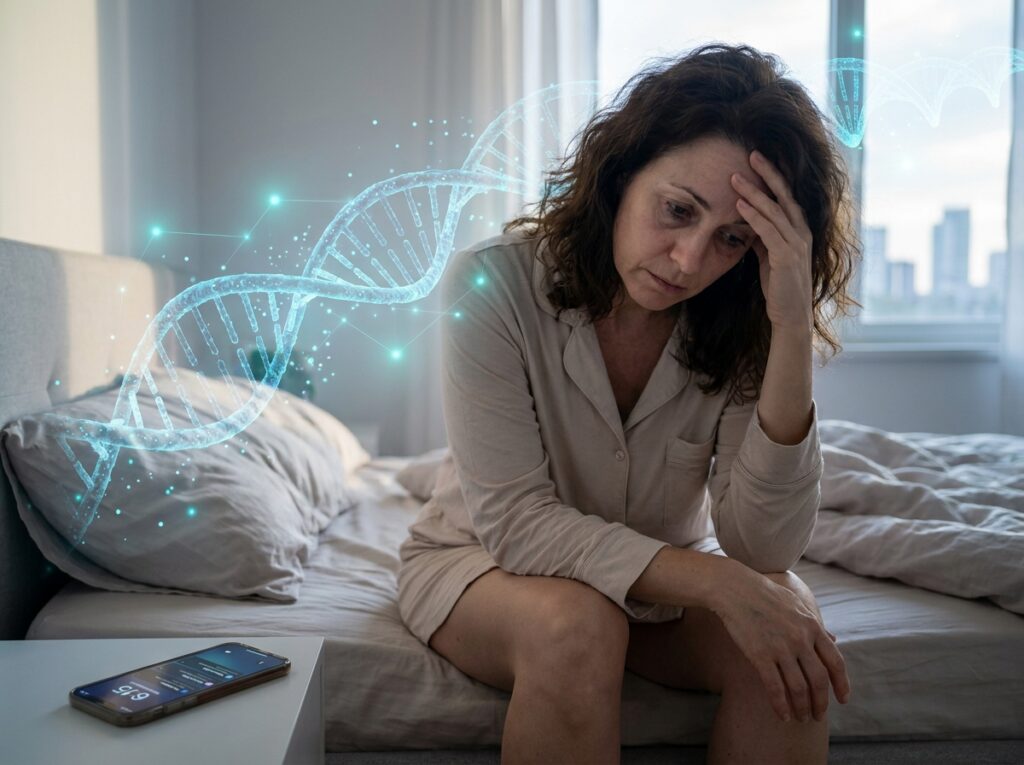
Before going further, a distinction worth making clearly: poor sleep does not rewrite your genetic code itself — your DNA sequence remains the same. What changes is gene expression — which genes are switched on, which are switched off, and how actively they are working.
This field is called epigenetics, and it is one of the most rapidly evolving areas of biology. Epigenetic changes determine how your genetic blueprint is read and executed by the body. They influence everything from how efficiently your immune system responds to a virus, to how your cells manage inflammation, to how accurately your DNA repairs itself when damaged.
In other words: your genes are not just a fixed instruction manual. They are a dynamic, responsive system — and sleep is one of the most powerful regulators of that system.
When sleep is disrupted, that regulatory signal becomes noise. And the body, at the cellular level, begins to reflect the chaos.
What the Research Actually Found
The University of Surrey study asked participants to sleep either 5.7 hours or 8.5 hours per night for one week. Researchers then analyzed gene expression patterns from blood samples.
The results were striking on two levels.
First, the number of affected genes was far larger than anticipated. 711 genes showed altered expression — some significantly upregulated, others suppressed. These were not peripheral genes. They included genes central to:
- Immune system activation and regulation
- Inflammatory response pathways
- Stress hormone processing
- Circadian clock function (the internal timing system that coordinates virtually every biological process)
- DNA repair mechanisms
Second, and perhaps more importantly, the direction of change was consistent with disease risk. Genes associated with inflammation were turned up. Genes associated with immune precision and cellular repair were turned down. The genetic profile of sleep-deprived participants, in other words, began to resemble the profile seen in people with elevated risk for chronic disease.
A subsequent study from the University of California, Berkeley added another dimension: sleep deprivation was found to impair the activity of natural killer cells — the immune system’s frontline defenders against infected and cancerous cells — by up to 70% after just one night of poor sleep.
One night.
The Inflammation Connection
Of all the genetic changes associated with poor sleep, the most clinically significant is the consistent upregulation of inflammatory pathways.
Chronic low-grade inflammation is now understood to be a driver — not just a symptom — of most major chronic diseases: cardiovascular disease, type 2 diabetes, Alzheimer’s disease, certain cancers, depression, and autoimmune conditions. It is the common biological thread running through conditions that, on the surface, seem completely unrelated.
Sleep is one of the primary mechanisms through which the body resolves inflammation each night. During deep sleep, anti-inflammatory cytokines are released, stress hormones drop, and the immune system performs its maintenance and repair functions.
When sleep is consistently disrupted, this nightly resolution process is interrupted. Inflammatory markers accumulate. Over weeks, months, and years, that accumulation begins to express itself in the body in ways that look like aging, illness, and decline — but which are, at their root, the compounded cost of nights the body never fully recovered from.
The Circadian Clock: Your Body’s Master Gene Regulator
One of the most important findings in recent sleep science is how deeply sleep deprivation disrupts the circadian clock — the internal 24-hour timing system that coordinates gene expression across virtually every cell in the body.
The circadian system does not just regulate when you feel sleepy. It controls the timing of hormone release, immune function, metabolism, cell division, and DNA repair. Roughly 80% of protein-coding genes in the human body follow a circadian rhythm of expression — meaning they are designed to be active at certain times and quiet at others.
When sleep is disrupted, the synchronization of these rhythms breaks down. Genes that should be active during sleep are suppressed. Genes that should be quiet are activated. The result is a body operating on mistimed instructions — performing the right processes at the wrong times, or not performing them at all.
This is why shift workers — whose circadian rhythms are chronically disrupted — show significantly elevated rates of metabolic disease, cardiovascular disease, and certain cancers. The gene expression disruption is not theoretical. It is measurable, consistent, and consequential.
Is the Damage Reversible?
This is the question that matters most — and the answer is cautiously reassuring.
The University of Surrey study found that when participants returned to normal sleep, many of the gene expression changes began to reverse. The body has a remarkable capacity to restore equilibrium when given the conditions to do so.
However, two important caveats apply.
First, recovery is not immediate. Some gene expression patterns take longer to normalize than others. The immune suppression associated with even a single night of very poor sleep may take several nights of good sleep to fully restore. Chronic, long-term sleep disruption creates more entrenched epigenetic patterns that are harder to reverse.
Second, the key word is “many” — not all. Some epigenetic changes associated with chronic sleep deprivation appear to persist even after sleep is restored, particularly in older adults. This does not mean the damage is permanent, but it does mean that the framing of “I’ll catch up on the weekend” is biologically inadequate.
Recovery is real. But prevention is significantly more powerful than recovery.
What Healthy Sleep Actually Looks Like at the Cellular Level
For gene expression to follow its intended pattern, sleep needs to meet three criteria — not just duration, but depth and consistency.
Duration: Adults require 7 to 9 hours per night for full biological restoration. Below 6 hours, gene expression changes become detectable. Below 5 hours, they become significant.
Depth: The most critical repair processes — including growth hormone release, immune cell activity, and memory consolidation — occur during slow-wave (deep) sleep and REM sleep. Alcohol, sleep aids, and environmental disruptions can produce sleep that meets the duration threshold but suppresses these deeper stages, leaving the body underrestored despite hours in bed.
Consistency: The circadian clock is exquisitely sensitive to timing. Going to bed and waking at consistent times — even on weekends — is not a rigid lifestyle preference. It is the primary signal that keeps the body’s master gene regulator synchronized.
6 Evidence-Based Steps to Protect Your Gene Expression Through Sleep
1. Anchor your wake time first.
The most powerful circadian signal is light exposure upon waking. Get bright natural light within 30 minutes of waking — it sets the clock for the entire day and makes falling asleep at the right time significantly easier.
2. Keep your sleep and wake times consistent within 30 minutes — every day.
Circadian rhythm research consistently shows that consistency of timing matters as much as duration. Irregular schedules produce measurable increases in inflammatory markers even when total sleep hours are adequate.
3. Drop your bedroom temperature to 18–20°C (65–68°F).
Core body temperature must fall 1 to 2 degrees to initiate and maintain deep sleep. A cool sleeping environment accelerates this process and increases the proportion of slow-wave sleep — where the most critical cellular repair occurs.
4. Eliminate alcohol within 3 hours of sleep.
Alcohol is widely misunderstood as a sleep aid. It suppresses REM sleep and slow-wave sleep — producing sedation rather than genuine rest. Even moderate alcohol consumption measurably reduces sleep quality at the gene expression level.
5. Treat your last 60 minutes before bed as a biological wind-down.
Bright light and screen exposure suppresses melatonin production. Dim your environment, avoid screens, and allow your core temperature and cortisol levels to begin their natural descent. This is not optional — it is the physiological on-ramp to deep sleep.
6. Address sleep disruption early — before it becomes chronic.
Occasional poor sleep is a human universal. The cellular consequences become significant when disruption is sustained over days and weeks. If you have been sleeping poorly for more than two weeks, treat it as a health issue — because at the level of your genes, it already is one.
The Bottom Line
Sleep is not passive. It is not simply the absence of wakefulness. It is an active, complex biological process during which the body performs maintenance, repair, and regulation that is simply not possible any other way.
Every night of poor sleep is a night during which that process is interrupted — and your genes, with quiet precision, register the fact.
The good news is that the body wants to recover. It is designed to restore. But restoration requires the one thing no supplement, no biohack, and no morning routine can replace: genuine, consistent, deep sleep — night after night.
Your DNA is keeping score. It is worth deciding what score you want it to keep.
This article is for informational purposes only and does not replace professional medical advice. If you suffer from chronic sleep disruption, insomnia, or suspected sleep apnea, consult a qualified healthcare professional.