
If you asked your mother or grandmother how to care for a newborn’s umbilical cord stump, the answer would probably come instantly: “Put alcohol on it three times a day.” It was treated as absolute truth, passed down from generation to generation. In older maternity wards, healthcare professionals themselves taught it as the standard protocol.
The problem is that science moved forward — and the recommendation changed. Today, the World Health Organization, the Brazilian Ministry of Health, and pediatric associations recommend that, under normal hygienic conditions, the umbilical cord stump should simply be kept clean and dry, without alcohol or any other substance applied to it.
Yet most mothers still use alcohol. Some because nobody updated the information during prenatal care. Others because family members insist. And many because, during the uncertainty of those first days with a newborn, any familiar routine feels safer than being told to “do nothing.” So let’s understand what actually works — and why.
What Is the Umbilical Cord Stump?
During pregnancy, the umbilical cord is the baby’s lifeline. Through it flow oxygen, nutrients, and hormones essential for fetal development. It consists of two arteries and one vein surrounded by a gelatinous substance called Wharton’s jelly.
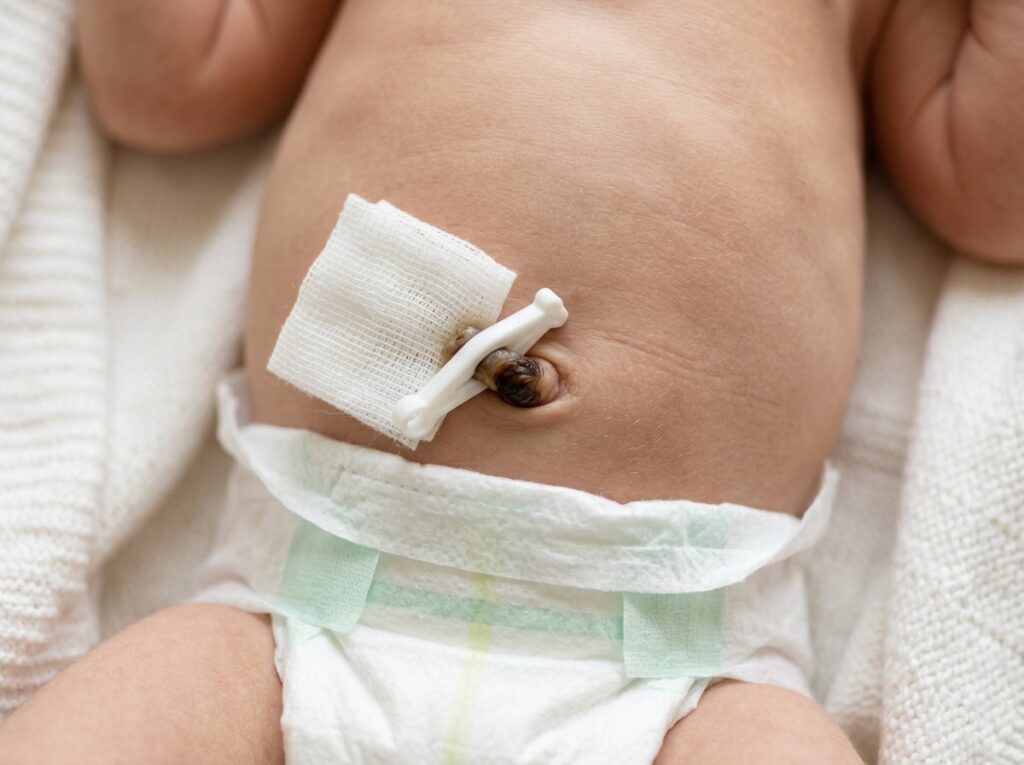
At birth, the cord is clamped and cut. The small piece that remains attached to the baby’s belly button is called the umbilical cord stump.
After being cut, this tissue naturally begins a process of drying and mummification: it shrinks, hardens, darkens — changing from yellow-green to brown and eventually black — before falling off on its own. This usually takes between 7 and 21 days, although in some babies it may take up to 4 weeks without representing any problem.
Why Alcohol Was Abandoned
For decades, 70% alcohol was the standard care method worldwide. The logic seemed reasonable: disinfect the area, prevent infection, and keep it clean.
But studies beginning in the 2000s showed that alcohol, by killing bacteria indiscriminately, also destroys the beneficial microorganisms that naturally colonize the stump and help with healing. In addition, alcohol irritates the tissue, may cause dermatitis around the skin, and — contrary to expectations — actually delays the stump from falling off compared to dry cord care.
A systematic review published in the Cochrane Database analyzed studies comparing alcohol, antiseptics, and dry cord care. The conclusion was that dry cord care resulted in faster cord separation without increasing infection risk in environments with good hygiene.
It’s important to emphasize that this recommendation applies to countries and households with access to clean water, proper hygiene, and medical care. In regions with a high risk of neonatal infection, chlorhexidine may still be recommended. But for most families living in normal hygienic conditions, dry cord care is the correct approach.
How to Care for the Umbilical Cord Stump
The good news is that proper care is also the simplest care. The secret comes down to two words: clean and dry.
Keep the Stump Exposed to Air
Avoid covering the stump with the diaper. Fold the front of the diaper downward so the stump stays exposed. Many newborn diapers already include a cutout for this purpose. Air exposure speeds up the drying and separation process.
Avoid Moisture
Moisture is the stump’s biggest enemy. Avoid tub baths until the stump falls off — sponge baths are preferred. If the stump accidentally gets wet, gently dry it with sterile gauze or a dry cotton swab using soft movements around the base.
Never Pull the Stump Off
Even if the stump appears barely attached, never force it. It needs to fall off naturally when ready. Pulling it too early may cause bleeding and increase the risk of infection.
Don’t Apply Any Substance Without Medical Advice
No alcohol, ointments, oils, herbs, powders, or mercury-based products. Unless specifically recommended by the pediatrician, the stump does not need any product at all. Unnecessary applications interfere with the natural healing process.
Dress the Baby in Loose, Comfortable Clothing
Onesies and outfits that don’t compress the abdominal area are ideal. Tight clothing creates friction and moisture — two things that slow proper healing.
What to Expect When the Stump Falls Off
The stump usually falls off between 7 and 21 days after birth. Some babies lose it within the first week, while others take up to 4 weeks. Both can still be normal as long as there are no signs of infection.
As the stump prepares to fall off, it becomes darker, shriveled, and slightly loose at the base. A few drops of blood at the moment it separates are completely normal. Afterward, a small moist wound may remain, healing naturally over the next few days.
If the stump has not fallen off after 4 weeks, mention it to the pediatrician. In rare cases, delayed separation may be associated with conditions such as congenital immune deficiencies.
Signs of Infection: What to Watch Closely
Omphalitis — infection of the stump and surrounding area — is uncommon when proper care is followed, but it can become serious very quickly in newborns. Warning signs include:
- Intense redness around the stump, especially if spreading onto the abdominal skin
- Swelling around the belly button
- Strong foul-smelling discharge — different from the mild earthy smell of normal drying
- Yellow or green pus-like drainage
- Fever in a newborn — any temperature above 100°F (37.8°C) in babies younger than 3 months requires immediate medical evaluation
- Intense crying when the area around the belly button is touched
- Persistent redness and moisture after the stump falls off
It’s important to distinguish the normal mild smell of tissue drying from the foul odor associated with bacterial infection. When in doubt, call the pediatrician. With newborns, being cautious is never an overreaction.
Umbilical Granuloma: When Tissue Remains After the Stump Falls Off
After the stump separates, some parents notice a small red, moist, shiny bump remaining inside the belly button. This is called an umbilical granuloma — scar tissue that forms when healing does not complete properly.
A granuloma does not hurt, but it may produce mild discharge and delay final healing. Treatment is simple and performed by a pediatrician using silver nitrate applied directly to the tissue, usually resolving it in one or two sessions.
Do not attempt home remedies. Do not apply salt, creams, or any substance without medical guidance. Although it may look alarming, an umbilical granuloma is benign and easily treated.
Common Questions From Parents
Can I Give My Baby a Tub Bath Before the Stump Falls Off?
It’s not recommended. Prolonged contact with water softens the stump and delays separation. Sponge baths are preferred until complete healing.
My Baby’s Stump Has a Strange Smell. Is That Normal?
A mild characteristic smell during the drying process is normal. But if the odor becomes strong, foul, or comes with redness and discharge, contact your pediatrician.
Can I Use Chlorhexidine Instead of Alcohol?
Only if recommended by your pediatrician. Under normal hygienic conditions, no antiseptic is necessary.
The Stump Fell Off and There’s a Little Blood. What Should I Do?
A small amount of bleeding is normal. Gently clean the area with sterile gauze and monitor it. If bleeding continues or becomes more than a few drops, seek medical advice.
Conclusion
Umbilical cord stump care is much simpler than most parents imagine — and very different from what previous generations were taught. Less is more: no alcohol, no ointments, no unnecessary intervention. Just attention, basic hygiene, and respect for the baby’s natural healing process.
The greatest gift you can give your newborn’s cord stump is to leave it alone — clean, dry, and exposed to air — while it does exactly what it was designed to do from birth.
And if any doubt arises, your pediatrician is only a phone call away. During the first days of a baby’s life, no question is too small.
Know an expecting mother or someone who just had a baby? Share this article — this information can make a huge difference during those first days at home.